

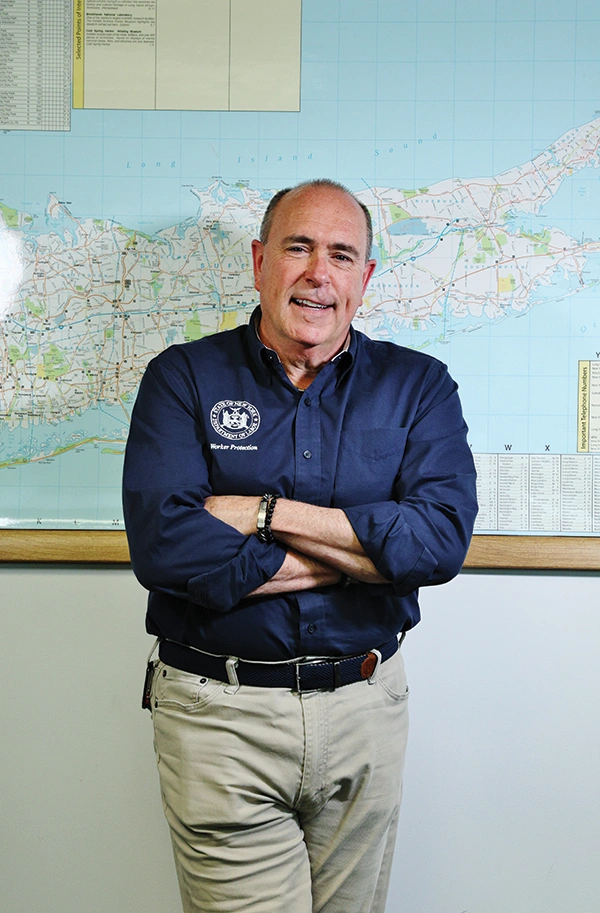
 Matthew Myers’ career is a testament to the value of hard work, perseverance, and the lasting impact of education and integrity. Over his 36-year career in public service, Matt has not only climbed the ranks but has also seen the tremendous change that public service can bring to individuals’ lives. His early days as a field investigator led to his current role as Chief of Downstate Operations for the New York State Department of Labor (NYSDOL) Bureau of Public Work — a title that doesn’t roll off the tongue, but then again, neither does the complexity of the work he oversees. Prevailing wage enforcement. Apprenticeship regulation. Multi-agency investigations. Massive restitution cases. His job — like his story — is layered, deeply rooted in labor history, and driven by a strong, unwavering compass.
Early Lessons in Service
For Myers, the journey began with the realization that every day in the field brought something new to learn. When he started working for NYSDOL, the landscape was very different. The workforce was evolving, as was the focus on ensuring workers receive fair pay for their work. Myers recalls the often-overlooked issue of wage theft and its economic implications. The more he worked, the more he became an advocate for justice. Myers’s ability to learn quickly and grow through experience earned him the trust of his colleagues and supervisors alike.
Over the years, he found himself deeply involved in efforts to enforce prevailing wage laws, ensuring that workers received fair compensation. “It’s an economic crime,” he often said, reflecting on the importance of his work in maintaining a fair and just economy. As Myers’s career progressed, he was given more responsibilities, but it wasn’t the authority that mattered most to him — it was the ability to impact people’s lives for the better.
A New Understanding of Work and the Community
One of the most defining moments of Myers’ career came with his involvement in Hurricane Sandy’s aftermath. The devastation along Long Island’s coast left Myers with firsthand insight into the challenges faced by workers trying to rebuild homes and businesses. But it wasn’t just about getting the work done — it was about ensuring that the workers doing this critical work were treated fairly. He found himself working alongside various teams to enforce safety standards and fair compensation during the recovery process.
“I learned a lot about what people call the ‘storm chasers,'” Myers reflected. These were contractors from out of town, often unscrupulous, trying to take advantage of people during a vulnerable time. Through this experience, Myers became an even stronger advocate for project labor agreements (PLAs), which he believes are crucial in ensuring both fairness and efficiency in recovery efforts. While he had no direct enforcement power over PLAs, Myers made it clear in his discussions with policymakers that these agreements were vital in promoting fair wages and stabilizing the workforce during large-scale recovery efforts going forward.
Building Investigations, Brick by Brick
One of Myers’s proudest contributions was a major case at Stony Brook University, involving coordination with the Suffolk County District Attorney’s office. The investigation began with Myers himself as the lead before he passed it along to his team.
“We ended up partnering with ADA Nicolino and worked closely with Patricia Smith, the Commissioner at the time,” he says. “It was one of those moments where you could see policy, law enforcement, and labor protections all come together.”
The collaboration eventually led to legislative changes. “It created a precedent,” Myers says. “We’re still working with the DA’s office today. In fact, one of my investigators now is a liaison with the Suffolk DA.” For Myers, the success wasn’t just in the legal outcome — it was in the relationships and standards that were set.
Myers recalls how the case was handled in collaboration with the Suffolk County District Attorney’s office. The outcome was life-changing for 53 workers who received a total of $1.1 million in back pay. “That’s what you get up for every day,” Myers said, reflecting on the case’s impact. This victory wasn’t just about the money — it was about giving workers back their dignity and ensuring they could provide for their families.
The Role of Mentorship and Leading by Example
As his career progressed, Myers took on a new role: mentor. He recalls the day he received his first longevity bonus after 33 years of service. This milestone was not just a personal achievement but also a reflection of his commitment to the work. “It’s about the long haul,” he says. For Myers, it wasn’t just about advancing in his career — it was about making sure the next generation of public service workers understood the value of their work.
When Myers and his colleagues were given the opportunity to hire new investigators, they did so with a focus on the qualities that would contribute to a positive and impactful team. It wasn’t enough for these new hires to have technical skills — they had to be committed to the mission of public service. This philosophy came from years of experience on the job, where Myers learned that hands-on involvement was the key to understanding and addressing the real needs of workers on the ground.
Talk to Myers long enough and one theme becomes clear: he sees public service as a mission, not just a job. That’s especially true when it comes to training and mentoring the next generation.
“We hired a young man a few years ago, 24 years old,” he says. “I told him — if you’re in this for the long haul, there’s something noble about public service. You’re not gonna get rich. But you’re gonna make a difference.”
Myers looks for more than résumés in a new hire. “I want someone who cares,” he says. “Someone who puts themselves in the shoes of a worker. That’s how you build a good investigator.”
He’s quick to point out that some things can’t be taught in a training module. “You can’t replace experience,” he says. It’s why Myers refuses to give up field work, even as he oversees the Bureau’s Downstate operations. “If I don’t know the new system, how can I expect my people to use it?” he says. “If I don’t walk the beat, how can I ask them to?”
Work and Home, Woven Together
Despite his professional accolades — and there are many — Myers lights up most when talking about his family. He and his wife take trips to Ireland, her ancestral homeland. Sunday dinners now include 20 and as many as 24 people when extended family gathers.
“I put the chef hat on,” he laughs. “Spaghetti and meatballs is the easiest thing to make for a crowd.”
There’s a throughline between the way he talks about his family and the way he talks about his work: humility, responsibility, and heart. “It’s a joy,” he says, “watching them grow, having our blended family, seeing them build their own lives.” These moments aren’t tangents — they’re context. They’re the life that fuels the labor.
The Weight of Impact
One story anchors Myers’s sense of purpose. It’s about a worker from the Stony Brook case who received $108,000 in back wages. He called Myers directly to say thank you.
“He told me, ‘Now I can buy my family’s house,'” Myers recalls, his voice softening. “That’s impact. That’s real. That changes lives.”
As Myers approaches the final chapters of his career, he remains as committed as ever to his work and the people he serves. His decision to remain in the field, even as he rose through the ranks, is a testament to his belief that to lead effectively, you must stay connected to the work. His work ethic and dedication continue to influence the department and the broader community he serves.
As he reflects on a career that’s spanned more than 36 years — and touched thousands of workers’ lives — Myers doesn’t boast. He’s more likely to talk about the people around him, the investigators he’s mentored, the colleagues he’s admired.
In an era where cynicism about government is easy to find, Matthew Myers offers something rare: belief. Belief in the value of public service. In the dignity of labor. In the power of justice — slow, imperfect, but real — to make people whole.
He isn’t flashy. He doesn’t chase the spotlight. But in the quiet hum of New York’s labor enforcement engine, he is one of the gears keeping it turning.
And if you ask him what gives him joy? He won’t mention awards or promotions. He’ll talk about his grandkids laughing. A good martini. A dinner table crowded with family.
And maybe, just maybe, a call from a worker who finally got paid what he was owed.