

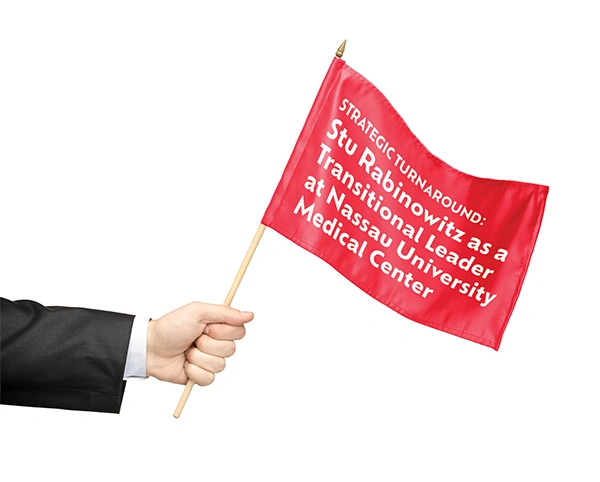
There are certain people who, when told something cannot be done, hear it as a challenge.
“Everybody said, ‘Don’t do it. Because it can’t be done,’” Stu Rabinowitz once said with a slight smile. “That’s like waving a red flag.”
For more than two decades, Rabinowitz built a reputation as a leader willing to step into moments of institutional uncertainty. As president of Hofstra University, he transformed a regional campus into a nationally recognized university, growing the endowment from $90 million to $900 million, launching a medical school, and building new facilities.
When New York State faced deep instability at Nassau University Medical Center, Governor Kathy Hochul turned to Rabinowitz as a transitional chair because of his experience with institutional reinvention and credibility in complex environments. His role was understood from the beginning as temporary but essential: to stabilize the hospital’s governance, operations, and finances.
A Hospital in Crisis
The situation Rabinowitz stepped into was not a typical administrative challenge. NUMC was suffering leadership collapse, operational chaos, and extreme financial disarray after years of neglect, turnover, and systemic strain. The institution had no effective executive leadership in place, with the CEO and multiple senior executives departing amid mounting turmoil and financial instability.
Internal systems were so compromised that critical operational information was inaccessible, with computers damaged and vital files compromised, creating an information vacuum that made basic financial oversight nearly impossible. In some cases, records were missing or shredded, hampering the hospital’s ability to understand its own operations and budget trajectory.
At the same time, NUMC was projecting a massive operating deficit exceeding $167 million in its 2026 budget, with little reliable data to inform a credible recovery plan.
Stabilizing Leadership
Recognizing that nothing short of a reset was required, Rabinowitz helped assemble a new leadership framework from scratch. To build an accurate financial and operational picture, he hired an interim CEO, brought in a nationally regarded healthcare law firm for governance and compliance work, and engaged Deloitte to conduct a comprehensive financial and operational assessment.
With these supports in place, he worked to establish a credible leadership team composed of experienced hospital interim executives who could immediately address the deep dysfunction. This team began reconstructing the institutional knowledge base that had been lost, restoring both visibility into the hospital’s finances and accountability for its operations.
A Mandate to Stabilize
The scale of the challenge was neither abstract nor cosmetic. Years of deferred maintenance, unmanaged capital needs, and compliance pressure had left the physical plant and administrative systems strained. At the same time, NUMC’s role as a major safety-net provider in Nassau County meant patients could not be sidelined while reforms took place.
Rabinowitz rejected the idea of drift. “Ten years is too long,” he insisted during his tenure. “You can’t go on for ten years, needing a couple hundred million dollars from the state every year to meet your budget.” Five years, he suggested, should have been the outer boundary for structural change.
Under his leadership, the board was tasked with outlining a strategic roadmap for the Governor’s office. The aim was not to deliver a prescriptive final blueprint but to establish a financially sustainable strategic framework that charts a path forward for the institution.
A Builder’s Mindset
Fundraising and institutional persuasion have long defined Rabinowitz’s career. At Hofstra, he demonstrated that growth followed belief. The university’s expansion required convincing donors that the institution’s ambitions were credible and supported by a track record of delivery.
At NUMC, the objective was different but related: stability rather than prestige. During his tenure, Rabinowitz helped secure private support for essential clinical upgrades and worked to demonstrate that progress can be visible and meaningful even in a hospital facing existential pressures.
“You have to prove it,” he said. Words alone were not enough. Visible improvements, from equipment upgrades to operational clarity, were essential to rebuild trust both internally and externally.
He was equally direct about organizational culture. Changing financial models is complex; changing mindset can be harder. Staff shaped by years of uncertainty needed to see that progress was possible. Earlier in his career, Rabinowitz had told skeptics, “Watch us.” At NUMC, he sought to instill that same forward-looking confidence through disciplined execution rather than rhetoric.
A Transitional Chapter
From the outset, Rabinowitz’s role was understood as transitional. It was a defined period of stabilization under state oversight, guided by a leader experienced in institutional reinvention. His mandate was to impose governance clarity, restore fiscal discipline, and help frame a viable strategic direction from what had been organizational chaos.
With the strategic framework outlined and the enterprise repositioned for the next phase, Nassau University Medical Center is moving beyond immediate crisis management into a period of rebuilding that will require sustained political cooperation, financial discipline, and cultural cohesion.
A Personal Imperative
Rabinowitz’s sense of service has long traced back to his upbringing in the Bronx. He grew up in a two-bedroom apartment shared by five, with parents who had not finished high school and a father who drove a cab. He often reflected on the improbability of his career path, from lawyer to dean to university president and institutional turnaround leader.
Long Island became both home and opportunity. “I made my retirement from Long Island,” he once said. Giving back, particularly through healthcare access for the uninsured and underinsured, felt personal. He was candid about what concerned him most during his tenure: whether NUMC would succeed in fulfilling its mission for the community it serves.
Letting the Institution Move Forward
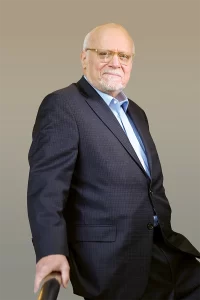 Rabinowitz’s leadership style has never been theatrical. It has been methodical, persuasive, and rooted in the belief that institutions can change when accountability and compassion align. He did not promise certainty, and he acknowledged obstacles openly.
His stewardship can best be understood not as an endpoint but as a bridge. It was a period of disciplined stabilization during which a troubled institution was confronted directly, informed with accurate data, and positioned for long-term transformation.
For Rabinowitz, the challenge was accepted when others hesitated. The challenge, and the future, now rest with those who carry the institution forward.