

On a seven-acre property designed to mirror the conditions laborers encounter in the field, members of Laborers Local 1298 are learning how to work more safely, efficiently and confidently. During a recent tour led by Dennis Feeney and Business Manager George Truckio, Road Warriors received an inside look at the union’s growing training program and its commitment to preparing members for the realities of modern construction.
A Training Ground Built for Real Work
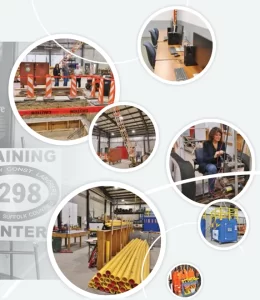
The facility has a clear mission: improve members’ skills, strengthen safety practices and provide signatory contractors with a more productive workforce. Instead of limiting instruction to classrooms and manuals, Local 1298 has developed outdoor training areas where members can operate equipment, practice essential construction tasks and learn to recognize hazards before encountering them on an active job site.
A roughly 2,000-foot trail system winds through the wooded property, providing space for clearing, maintenance, chainsaw instruction and equipment training. The trails were initially created by operating machinery along the natural path of the property.
“We kind of just took the path of least resistance with the machine,” Feeney explained during the tour.
Elsewhere on the property, concrete slabs are poured so members can practice cutting with demolition saws. A test-pitting area is being developed to teach hand digging and excavation, skills that remain essential even on increasingly mechanized construction sites.
“I get big complaints. Guys don’t know how to dig. They can’t dig holes. They can’t put fence posts in,” Feeney said while describing the planned training area.
Future additions will support road building, curb grading, sidewalk installation, landscaping and manhole placement. The goal is to give apprentices and newer members hands-on exposure to tasks they will regularly perform in the field, from setting forms and installing pipe to bringing manhole covers to grade.
Safety Through Hands-On Experience
Grant funding has supported trench-safety infrastructure that includes barricaded work zones, concrete structures and pits for practicing wood sheeting and protective systems. A manhole simulator allows members to train for confined-space entry, harness use and emergency procedures in a controlled environment. The site also includes a makeshift crane for teaching hoisting, rigging, hand signals and radio communication.
Inside, the training shop contains chainsaws, demolition saws, concrete mixers, hand tools and personal protective equipment. AEDs, first-aid kits and an emergency shower reinforce the message that preparation for an emergency must be part of every construction operation.
The facility maintains a strict personal protective equipment policy requiring hard hats, safety glasses, gloves, high-visibility vests and work boots. Members who arrive without proper equipment may be turned away, just as they would be unable to work safely on a job site.
“We expect it to be followed,” Feeney said of the PPE policy. “If we issue one warning during the day, the second time, you’re dismissed for the day.”
The classrooms accommodate both small-group instruction and larger training and recruitment sessions. A smaller room is used for apprentice orientations, videos and group discussions, while a larger divisible classroom can support bigger programs. The flexible layout allows instructors to combine classroom lessons with immediate hands-on application.
A Curriculum Built for the Industry
 Local 1298’s general construction program includes approximately 80 hours of instruction modeled after training offered at LIUNA centers across the country. Course materials are developed through the Laborers’ International Union of North America, Cornell University and the New York State Department of Transportation. The curriculum is continually reviewed to reflect changing regulations, equipment and industry practices.
“We’re not just slapping something together on a piece of paper,” Feeney emphasized while displaying the curriculum and training materials used in its courses.
Work-zone safety is among the program’s most urgent priorities. Maintenance and Protection of Traffic awareness, flagging and traffic-control instruction help members understand how to establish and work within active traffic zones. Local 1298 is encouraging contractors to make this training a priority for every member assigned to roadway work.
“Working in the road is so dangerous,” he said. “It’s more important that we train.”
That urgency is deeply personal for those who have spent their careers working alongside traffic. Feeney recalled being struck by a vehicle while working in a detour approximately 25 years ago. He also described being partially buried in a trench collapse at age 19. The excavation program teaches members to recognize safe and unsafe conditions and to refuse to enter an improperly protected trench, regardless of pressure to complete a task quickly.
First aid, CPR and AED courses are taught by emergency medical technicians from the Smithtown Fire Department. The program focuses on the types of serious injuries that can occur on construction sites and prepares workers to respond during the critical minutes before professional assistance arrives.
“When we get hurt, we get hurt. We don’t get paper cuts,” Feeney said. “If something goes wrong on our jobs, you’re going to the hospital.”
Additional courses include OSHA 10 and OSHA 30, fire prevention, fire-watch responsibilities, 811 “Call Before You Dig” awareness and Long Island Rail Road track-safety training. Members can also receive instruction in concrete mixing and placement, backfilling, compaction, demolition-saw operation and chainsaw safety.
The tool-safety classes protect workers while also helping contractors avoid costly equipment damage.
“You don’t want to break Jimmy Pratt’s $2,500 chainsaw,” he joked. “And you don’t want to cut your arm off.”
Specialized instruction is responding to Long Island’s changing infrastructure needs. Basic poly-fusion training introduces members to equipment increasingly used on sewer, water-main and utility projects. Gas-fuser preparation helps participants prepare for National Grid certification examinations.
“This work is becoming more popular, the sewer and watermain work, and we want to make sure that we’re ahead of that,” the trainers explained. “We want to make sure that we have an adequate workforce to supply contractors.”
Preparing the Next Generation
The facility also plays a central role in Local 1298’s apprenticeship program. New groups of approximately 25 to 30 apprentices are prepared for the workplace through a combination of field experience and about 300 hours of training over approximately two to two and a half years. Once an apprentice begins working, the union has 30 days to formally indenture that individual with the state.
Local 1298 would like every participating contractor to employ an apprentice. Reimbursement may be available, particularly when apprentices are assigned to projects supported by state or federal funding.
“Every contractor should have an apprentice,” he said. “To be an active participant doesn’t mean you just pay in. You’ve got to take an apprentice. You’re participating in the program. You’ve got to have an apprentice on your payroll.”
The union is also considering moving from periodic application windows to continuous enrollment. Leaders believe open enrollment would create a stronger applicant pool, prevent interested candidates from being turned away simply because they arrived outside an application period and better align Local 1298 with LIUNA training centers nationwide.
“We don’t want to turn anybody away,” he said. “It’s better for the contractors. It’s better for our local. It’s better for the members. It’s just better for everybody.”
A Call for Greater Contractor Participation
Contractor participation remains critical. Training is already supported through employer contributions, so members do not pay an additional fee to attend. However, courses require advance planning because instructors, equipment and materials must be scheduled. When employers reserve classes but workers do not appear, training resources and instructor time are lost.
“We really want to get more contractor involvement because the guys listen to the contractors,” Feeney said. “We’re only here to help you better your career. It makes safer, more productive workers.”
The facility welcomes donations of surplus construction materials, including manhole covers, structural steel and wood timbers that can be incorporated into exercises. Used tools are not accepted because of safety and liability concerns, but assistance obtaining new materials at reduced prices is appreciated.
Taking Training to the Job Site
Outreach also extends beyond the facility through job-site visits and toolbox talks on hearing protection, skin-cancer prevention and other health and safety issues. Local 1298 has reached hundreds of members through these efforts and is encouraging more contractors to invite representatives onto their job sites.
The union is also involved in high school pre-apprenticeship initiatives in Brentwood, Roosevelt and Westbury, with hopes of expanding into additional school districts. Union meetings, health fairs and family events at the training facility are being considered as ways to introduce more members and their families to the opportunities available there.
Protecting Workers on Long Island’s Roads
Feeney and Truckio also support a greater police presence around roadway projects. They noted that even one marked police vehicle can cause drivers to slow down and pay closer attention.
“The presence of a police officer is better than anything else,” they agreed. “People are not going to speed through the work site. When I see a cop car, my foot comes right off the gas.”
Training alone cannot eliminate the dangers posed by distracted, impaired or speeding drivers. However, Local 1298 believes that a combination of properly trained workers, effective traffic-control plans, contractor involvement, police presence and greater public awareness can make roadway work zones significantly safer.
Training That Benefits the Entire Industry
The tour made clear that training is not simply a union benefit. It is an operational asset for the entire construction industry. A worker who understands excavation hazards, traffic control, emergency response and proper equipment use is better equipped to protect coworkers, prevent delays and contribute productively from the first day on the job.
For members, the facility offers a pathway to a lasting career. For contractors, it provides access to a safer and more capable workforce. For the traveling public, it means better-trained professionals are building and maintaining the infrastructure Long Island depends upon every day.
At Local 1298, every classroom lesson, concrete cut and practice trench advances the same mission: keeping workers safe while developing the skills that move the industry forward.