

“It is an incredible honor to serve as the
15th Superintendent of the United States
Merchant Marine Academy at Kings Point”
For Rear Admiral Anthony J. Ceraolo, coming to Kings Point feels, in many ways, like coming home.
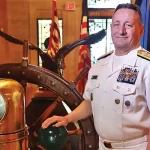 The Nesconset native officially became Superintendent of the United States Merchant Marine Academy in January after serving as Acting Superintendent since June 2025. But long before he was leading one of the Nation’s five federal service academies, Tony was a Long Island kid growing up surrounded by the water, transportation systems, and hardworking communities that shape so much of the region’s identity.
Now, after a 34-year Coast Guard career that took him from operational commands around the world to the White House National Security Council, Ceraolo finds himself back on Long Island helping shape the next generation of maritime leaders at one of the Nation’s most strategically important institutions.
“It is an incredible honor to serve as the 15th Superintendent of the United States Merchant Marine Academy at Kings Point,” Ceraolo said.
Talking with him, it quickly becomes clear that he sees the Academy as far more than a college campus.
“From my perspective, the Academy plays a vital role not only in shaping the next generation of mariners, but also the generations that will follow them,” he said.
A Career Shaped by Maritime Leadership
That responsibility feels especially significant today, as global instability, supply chain vulnerabilities, workforce shortages, and infrastructure modernization increasingly collide.
The United States Merchant Marine Academy occupies a uniquely important role within that conversation.
“The United States Merchant Marine Academy is unique among the Nation’s federal service academies,” Ceraolo explained. “Every graduate earns a Bachelor of Science degree, a United States Coast Guard license as either a Deck Officer or Marine Engineer, and a commission as an officer in one of the Armed Forces branches.”
“That combination creates leaders who are prepared to support both the Nation’s economic security and national defense interests in a rapidly evolving global environment.”
That intersection of commerce, transportation, logistics, infrastructure, and military readiness has defined much of Ceraolo’s own career.
Before arriving at Kings Point, he served on the National Security Council Staff at the White House as Director for Maritime Security and Director for Arctic Region Policy, where he helped develop Presidential Policy Directive-18 updating national maritime security policy and led development of the Nation’s first-ever National Strategy for the Arctic Region.
He later served as a Senior Counselor to the Secretary of Homeland Security, where he spearheaded and coauthored the Department of Homeland Security’s first Strategic Approach for Arctic Homeland Security.
Operationally, his experience includes commanding multiple Coast Guard cutters, serving as Commander of U.S. Coast Guard Patrol Forces Southwest Asia — the Coast Guard’s largest command outside the continental United States — and later serving as Sector Commander and Captain of the Port for San Francisco and Northern California.
Before retiring from the Coast Guard in 2023, he served as Executive Assistant to the Coast Guard’s Deputy Commandant for Operations, helping oversee strategy, operations policy, budget development, doctrine, and capabilities across a multi-billion-dollar enterprise.
Despite that résumé, Ceraolo still speaks with the groundedness of someone who understands the value of practical work and operational leadership.
The Maritime Industry’s Critical Role
“Our position at the crossroads of transportation, commerce, and national defense shapes every priority we set,” he said. “America’s economy depends on the reliable movement of goods, energy, and resources, while our national security depends on the ability to sustain and protect that movement during both peace and conflict.”
Those realities have become impossible to ignore in recent years. From supply chain disruptions and energy concerns to geopolitical tensions and infrastructure investment debates, the maritime sector has increasingly moved into public focus. Nearly 90 percent of global trade moves by sea, yet many Americans rarely think about the workforce responsible for sustaining that system.
“The United States relies on a highly skilled maritime workforce to sustain commerce and strategic mobility,” Ceraolo explained. “The Academy supports that mission by preparing licensed merchant marine officers who serve aboard commercial and military vessels and later bring their operational expertise to ports, logistics, transportation systems, shipbuilding, and related industries.”
That mission also increasingly overlaps with industries represented throughout Long Island’s construction and infrastructure sectors.
Building the Next Generation Workforce
“The Academy’s Sea Year program provides approximately a full year of apprenticeship training aboard U.S.-flagged vessels, giving students practical experience in vessel operations, propulsion systems, maintenance, logistics, and engineering in real-world environments,” Ceraolo said.
“Many of our graduates go on to leadership positions not only in the maritime sector, but also in construction, transportation, infrastructure, engineering, and logistics industries across the country, including here on Long Island.”
Sea Year remains one of the defining experiences of Kings Point. During their sophomore and junior years, midshipmen spend extended periods training aboard commercial and military vessels around the world.
“They gain firsthand exposure to global trade, shipboard operations, and leadership responsibilities at sea,” Ceraolo said. “In today’s increasingly contested and interconnected world, the Academy’s mission has never been more important.”
That real-world training shapes the qualities the Academy prioritizes in future leaders.
“We are focused on developing leaders who are technically capable, resilient, and committed to living up to our motto, Acta Non Verba — ‘Deeds, Not Words’ — while upholding our core values of respect, honor, and service,” he said.
“Technical proficiency is essential, but so is the ability to lead under pressure, make sound decisions, communicate effectively, and maintain the highest standards of accountability and character.”
Technology, Infrastructure, and the Future
Those leadership demands mirror challenges currently facing the construction and infrastructure industries themselves. Like heavy construction, maritime operations increasingly rely on advanced technology, complex systems management, and workforce adaptability.
“Technology integration, automation, cybersecurity, energy resiliency, and advanced systems management are becoming increasingly important across both the maritime and infrastructure sectors,” Ceraolo noted.
“Artificial intelligence, digital twins, advanced modeling tools, and integrated control systems are rapidly changing how industries design, build, operate, and maintain complex systems and facilities.”
At the same time, Kings Point itself is becoming one of Long Island’s most significant infrastructure projects.
Originally built during World War II, much of the Academy’s campus now requires extensive modernization to meet the demands of a 21st century maritime institution.
In April 2025, the Academy signed an interagency agreement with the U.S. Army Corps of Engineers to oversee an ambitious long-term Campus Modernization Program.
Working with a major international design firm, the Academy has developed what Ceraolo describes as “a 10-year, approximately $3 billion capital improvement plan focused on infrastructure modernization, deferred maintenance, resiliency, and future growth.”
Projects include new academic buildings, waterfront improvements, barracks renovations, maintenance facilities, student spaces, housing, utility upgrades, and a future Maritime Center of Excellence.
“The challenge is balancing the preservation of the Academy’s historic character while building the modern infrastructure necessary to support future generations of midshipmen,” Ceraolo said.
Opportunities for Long Island Industry
For Long Island contractors, engineers, marine construction firms, and infrastructure professionals, the opportunities are extensive.
“The Campus Modernization Program includes both new construction and major renovation projects involving academic, residential, administrative, support, and waterfront facilities, including pier and seawall improvements,” Ceraolo explained.
Marine construction, resiliency planning, utility modernization, institutional construction, and historic renovation expertise will all be essential as projects advance.
“The Academy’s project portfolio includes utility upgrades involving electrical, water, sewer, landscaping, and site infrastructure, along with marine construction projects such as pier and seawall improvements,” he said.
The Academy has already begun engaging directly with industry partners throughout Long Island.
“As USMMA advances its Campus Modernization Program, we are actively engaging with local industry partners throughout Long Island and the surrounding region,” Ceraolo said.
In partnership with the U.S. Army Corps of Engineers, the Academy recently hosted an Industry Day and plans additional outreach efforts moving forward.
“The best way to support the maritime sector is by maintaining strong relationships and listening to the professionals driving the industry every day,” he added.
Importantly, Ceraolo stressed that companies do not necessarily need traditional maritime backgrounds to contribute.
“Many companies are surprised to learn how transferable their expertise can be within the maritime environment,” he said. “As a federal institution with a large and evolving campus, USMMA relies on a broad range of partners across infrastructure, technology, logistics, professional services, utilities, facilities support, cybersecurity, sustainability, and operational modernization.”
 Looking Ahead
For contractors interested in upcoming work, all procurement opportunities will be publicly posted through SAM.gov.
“Depending on the project, acquisitions may utilize multiple procurement methods, including Design-Bid-Build, Design-Build, Design-Build to Budget, and Integrated Design and Construction approaches,” Ceraolo explained.
Beyond the construction and modernization efforts, however, Ceraolo consistently returns to a more human focus: preparing young people for leadership and service.
“No matter where their careers take them, we want our graduates to understand that leadership is ultimately about service,” he said. “Service to those they lead, to the maritime industry, and to the Nation.”
That perspective feels particularly resonant coming from someone who spent decades serving across military, operational, and policy environments before ultimately returning home to Long Island.
After years helping shape maritime policy and national security strategy at the highest levels of government, Rear Admiral Tony Ceraolo now finds himself guiding the next generation from the shores of Kings Point, where leadership, infrastructure, transportation, and national service all meet at the water’s edge.