Kyle Swaringen, P.E.
Director, Bridges & Structures Engineering
Suffolk County Department of Public Works
As beach season approaches, the urgency around the Smith Point Bridge is about safety. Suffolk County moved quickly to restore two-way traffic, ensuring the bridge can safely carry the surge of summer travel. This interim improvement was not a quick fix, but a carefully coordinated effort requiring strategy, engineering, and close collaboration across agencies and contractors to stabilize and maintain a vital link. At the same time, the County is advancing plans for a full bridge replacement, with construction expected to begin as early as this summer and projected to take approximately three years to complete.
Opening / The Moment
Two-way traffic has now been restored on the Smith Point Bridge. What did it take to get here?
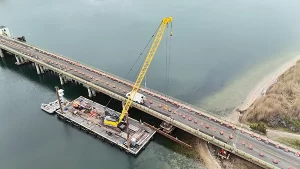 Two-way traffic was restored only after emergency crews stabilized the failing structure — most critically by installing a steel support-girder system to carry the load of the deteriorated concrete beams.
Was there a specific turning point or breakthrough that made reopening possible?
The moment that made reopening possible was when engineers finalized and installed the custom support-girder system designed to take over the load from the deteriorated concrete beams. Until that system was in place, the bridge simply couldn’t carry two-way traffic without risking further structural failure.
What Actually Got Done
What specific work or safety measures were completed to allow for the return to two-way traffic?
Restoring two-way traffic wasn’t just a matter of removing cones. It required a set of targeted structural safety measures to ensure the bridge could reliably carry full traffic loads again.
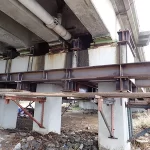
- Installation of the temporary support-girder system. This was the core structural fix. The new steel girders were designed to take over the load from the deteriorated concrete beams, creating a safe, redundant load path.
- Reinforcing and stabilizing weakened concrete areas of the existing beams. Crews reinforced deteriorated sections of the damaged concrete beams where deterioration was most advanced, preventing further cracking or deflection and allowing support from the temporary beams below.
What should the public understand about the complexity of this project that they may not have seen?
The deteriorated concrete beams meant the bridge couldn’t safely carry normal traffic. Designing and installing a custom support-girder system is not a simple repair; it is essentially creating a new structural backbone under an old structure.
That requires engineering calculations, fabrication, inspections, and careful installation — all under tight time pressure. Even though the bridge is slated for full replacement, the temporary system still must meet rigorous safety requirements.
The public may assume “temporary” means “quick and easy,” but in reality, temporary structural solutions often require just as much engineering as permanent ones.
Behind the Scenes
What did coordination look like between DPW, contractors, and other agencies?
Coordination on this project was far more involved than most people realize. Because the Smith Point Bridge is both structurally sensitive and the only access point to a major county destination, every decision required tight, real-time collaboration across multiple groups.
Here’s what that looked like behind the scenes:
- Daily communication between DPW, consultant engineers, and the contractor’s field teams.
- Coordination with traffic-control and public safety agencies. Because the bridge had to remain open in at least one direction at all times, the Suffolk County Department of Public Works coordinated with:
- Suffolk County Police for traffic management and safety oversight.
- Fire and EMS to ensure emergency access was never compromised.
- The Suffolk County Parks Department to plan around peak visitor hours.
- Scheduling and staging aligned across all parties. Crews couldn’t simply shut down the bridge to install the support girders. Instead:
- Work windows were planned around tides, weather, and traffic patterns.
- Equipment staging had to be approved by DPW to avoid blocking emergency routes and water navigation channels.
- Contractors coordinated material deliveries so they didn’t interfere with active traffic.
- Rapid decision-making under pressure. With summer approaching, all parties had to make decisions quickly — but safely.
Were there any innovative approaches or solutions used to accelerate progress?
One of the biggest accelerators in this project was the decision to allow the contractor to use stock steel sections instead of requiring custom-fabricated components. That choice made a huge difference in both timeline and logistics.
By approving standard, off-the-shelf steel sections, the contractor could source materials immediately rather than waiting for fabrication. Engineers adapted the temporary support-girder design to work with these available sections — a flexible, problem-solving approach that avoided major delays.
This decision allowed installation to begin much sooner, which directly accelerated the reopening of two-way traffic.
Impact
Now that two-way traffic is restored, what changes should commuters expect to feel immediately?
Commuters will feel the difference right away — and not just because delays shrink. Restoring two-way traffic changes how the whole bridge functions.
With alternating one-way traffic gone, drivers won’t be sitting at the light or waiting for opposing traffic to clear. The stop-and-go pattern that caused backups on both sides disappears.
How critical is this corridor, especially heading into peak summer season?
This corridor isn’t just important — it’s absolutely critical, and that becomes even more true as we head into the peak summer season. Smith Point County Park is the busiest park in Suffolk County, drawing huge volumes of visitors for beaches, camping, fishing, and day-use activities. And the Smith Point Bridge is the only roadway in and out.
That means:
- Every visitor, every staff member, and every emergency vehicle depends on this single corridor.
- Any restriction — even a minor slowdown — creates ripple effects for miles.
- Summer traffic surges dramatically, so delays multiply quickly if the bridge isn’t fully operational.
Looking Ahead
Is the bridge fully complete, or are there additional phases still to come?
The work that was just completed — including the temporary support-girder system and associated stabilization — is the full extent of what will be done on the existing bridge. No additional repair phases are scheduled.
The goal of this phase was to safely restore two-way traffic and keep the bridge functional while the replacement project moves forward. Because the bridge is already slated for removal, it wouldn’t be cost-effective or practical to invest in additional long-term repairs.
What should the public be watching for next in terms of infrastructure priorities?
The next big thing the public should be watching for is the start of construction on the brand-new Smith Point Bridge, which is scheduled to begin in summer 2026. This is the county’s major infrastructure priority for the corridor.
Once construction begins, it will mark the transition from temporary stabilization to a full, modern, long-term solution. The new span will eliminate the aging drawbridge structure, improve safety, and provide more reliable access to Suffolk County’s busiest park.
Early work will include staging, site preparation, and foundation work — all happening while the current bridge remains open. The temporary repairs completed now are designed to safely carry traffic until the new bridge is ready. Only after the new span opens will the old bridge be removed.
What does successfully reopening the Smith Point Bridge say about what’s possible when infrastructure is prioritized?
- When infrastructure is prioritized, problems get solved quickly and safely. The bridge had serious structural issues, yet the county, engineers, and contractors moved with urgency. They didn’t wait for conditions to worsen — they acted, stabilized the structure, and restored full traffic flow.
- Collaboration accelerates progress. DPW, contractors, inspectors, and public safety agencies worked in sync. That level of coordination isn’t automatic — it happens when leadership makes the project a priority and everyone commits to the same goal.
- Smart, flexible engineering can overcome tight timelines. Allowing the use of readily available stock steel sections is a perfect example. Instead of waiting for custom fabrication, the team adapted the design to materials that could be sourced immediately. Prioritizing the project meant prioritizing solutions.